
TCS is confident of achieving a double-digit revenue growth in the current fiscal and will be targeting a similar performance in FY24 as well, a senior executive said on Tuesday. The largest IT services exporter's ability to achieve the number in FY24 will hinge on how the macroeconomic situation, including geopolitical tensions, commodity price pressures, inflation and financial tightening worries, play out, chief operating officer N Ganapathy Subramaniam told PTI. "(For) this year (FY23), probably we are there (double-digit growth).

WhatsApp India head Abhijit Bose and Meta's public policy head Rajiv Aggarwal have resigned from their positions, social media major Meta said on Tuesday. The development comes within a week of Meta announcing 11,000 lay-offs across the globe. The company has given charge of Meta India Public Policy to Shivnath Thukral who is currently serving as Director of WhatsApp Public Policy in India.

'Spending by the middle class is limited with a focus on savings. However, there is buoyancy at the top-end.'

Currently, companies are taxed in the jurisdictions in which they have a physical presence. However, digital businesses generate revenues from markets without a significant physical presence in a country.

India is trying hard to erase Indonesia's wariness about New Delhi, building security cooperation in the Indian Ocean and Pacific Ocean. If Indonesia decides to buy the Brahmos missile, it would further strengthen relations between the world's most populous nation and the most populous Islamic country.

Research and development (R&D) spending by BSE 100 companies has grown steadily, rising from 0.89 per cent of revenue in FY20 to 1.32 per cent in FY24, averaging around 1 per cent over the period in-between, according to data compiled from Bloomberg and company annual reports. Also, these companies more than doubled their R&D spending in absolute terms over these five years: From Rs 25,041 crore to Rs 63,072 crore. While this reflects a prioritisation of innovation, corporate R&D investment remains relatively conservative.

'Today, let us reaffirm our commitment to strive to realise Gandhiji's dreams. His watchwords, truth and nonviolence, will continue to remain relevant for the whole world. He also taught us that rights and duties are but the two sides of the coin - indeed, the true source of rights is duty. Today we recall his lessons in compassion too - compassion not only for our human neighbours but also for our other neighbours, namely, flora and fauna, rivers and mountains.'

The size of Reserve Bank's balance sheet increased by 11.08 per cent to Rs 70.47 lakh crore as on March 2024, leading to the highest-ever dividend payout to the government, according to the central bank's annual report. In actual terms, the increase was Rs 7,02,946.97 crore over Rs 63.45 lakh crore as on March 2023.

Tech and startup industry bodies have again pushed back against calls by telecom operators to bring over-the-top (OTT) services under a licensing regime similar to telcos, and open them up to taxation. Ahead of public consultations on the issue later this week, the Internet & Mobile Association of India (IAMAI), Nasscom and the US India Strategic Partnership Forum (USISPF), among others, have written to the government arguing against such efforts.

Union Finance Minister Nirmala Sitharaman on Tuesday commended Indian financial sector regulators for doing a "world-class job" and bringing greater transparency into the system. Underlining that she is not against questioning or critiquing regulators, Sitharaman said there is a need to be "extremely conscious" about contributions made by them as well. Speaking at the Financial Express Best Banks Awards, the finance minister said, "I strongly recommend that facts are taken on board before we discuss anything to do with the regulators, strictly speaking."

You have to make yourself visible and create opportunities for yourself, advises Gaurav Goyal, co-founder, Scalenut.

A key indicator of corporate efficiency may now be better than at any time since the turn of the millennium. The net working capital cycle - a crucial measure that tracks the time a company takes to convert current assets like inventory into sales and then collect the money from customers - has seen remarkable improvement. According to data from the Centre for Monitoring Indian Economy (CMIE), the average company needed nearly 90 days to complete this cycle in 1999-2000.

Indian technology industry has a "big opportunity" despite global macroeconomic challenges, said Rishad Premji, chairman of IT services firm Wipro, on Wednesday as he spoke about how Covid-19 had changed work. "My confidence is driven by two things: the rapid pace of digitisation across the world, and the shift in the mindset of stakeholders who engage with us as an industry," said Premji in Bengaluru while addressing industry leaders and civil servants at the Invest Karnataka 2022, the state's Global Investors Meet (GIM). Businesses are using technology for customers and employees: a trend marked by the shift to cloud computing and leverage of data.

The net direct tax collection so far this fiscal rose 19.41 per cent to Rs 14.70 lakh crore, reaching about 81 per cent of the full-year target, the income tax department said on Thursday. "The provisional figures of Direct Tax collections up to January 10, 2024, continue to register steady growth," the Central Board of Direct Taxes (CBDT) said in a statement. Direct Tax collection, net of refunds, stood at Rs 14.70 lakh crore which is 19.41 per cent higher than the net collection for the corresponding period of last year.

Wipro founder-chairman Azim Premji believes the Indian IT industry revenues will grow in double digits in the current financial year. Throughout the pandemic, which saw lockdown measures to curtail the spread of the virus, the information technology industry has kept the world running and has also adapted to the changes, Premji said, speaking at an event of the Bombay Chartered Accountants' Society on Tuesday evening. As per Nasscom, the IT industry revenues stood at $194 billion in FY21. The lobby group has ceased giving estimates of the topline growth a few years ago.

Global rating agency Moody's on Monday raised India's growth forecast for 2024 calendar year to 6.8 per cent, from 6.1 per cent estimated earlier, on the back of 'stronger-than-expected' economic data of 2023 and fading global economic headwinds. India's real GDP expanded 8.4 per cent year-over-year in the fourth quarter of calendar year 2023, resulting in a 7.7 per cent growth for full-year 2023. Capital spending by the government and strong manufacturing activity have meaningfully contributed to the robust growth outcomes in 2023, Moody's Investors Service said.

Given the high priority accorded to the manufacturing sector, several policy initiatives around the theme of Atmanirbhar Bharat have been set in motion to address its competitiveness and growth. Some notable examples include the PLI scheme and the employment-linked incentive scheme announced in the recent Union Budget. The Budget also announced the setting up of 12 industrial parks under the National Industrial Corridor Development Programme (NICDP).

India's gain will be an additional business of $300 million to $400 million per month if 10-11% of Bangladesh's export is diverted to Indian hubs like Tiruppur.

'Overall, compared to the previous episode, we are in a better shape because the vaccine is already out there and vaccination drives are proceeding'

Global capability centres (GCCs) are increasingly looking to tap into revenue opportunities from the Indian market, which is already a critical talent hub. While capturing the potential of the Indian market has been in the works over the past few years, it's only of late that companies are gaining momentum. India is home to more than 1,580 GCCs, with a total market size of $46 billion and growing at a compound annual growth rate (CAGR) of 11.4 per cent, according to a Nasscom-Zinnov report.

'...We should first look at and acknowledge what we have done to ourselves.' 'To not do so opens us to the accusation of rank hypocrisy and also reduces the stature of our globetrotting peaceniks,' asserts Aakar Patel.

Prime Minister Narendra Modi on Thursday suggested the G20 trade ministers to work collectively to ensure equitable competition between large and small sellers as there are challenges in the fast growing cross-border e-commerce. In a video message at the G20 Trade and Investment Minister's meeting here, he also emphasised on the need to address the problems faced by consumers in fair price discovery and grievance handling mechanisms. "Digitising processes and use of e-commerce have the potential to enhance market access. "I am glad that your group is working on the 'High Level Principles for the Digitalization of Trade Documents'. These principles can help countries in implementing cross-border electronic trade measures, and reduce compliance burdens.

This is the full text of the address to the nation by President Droupadi Murmu on the eve of India's 78th Independence Day.

India is well positioned to lead the global transitions of digital and artificial intelligence, energy, value supply chains, and the country's growth journey will shape the world's future, B20 India chair N Chandrasekaran said on Friday. In his address to the B20 Summit India 2023, Chandrasekaran, who is also the chairman of Tata Sons, asserted that India stands as a beacon of growth and positively stands out in the global economy, which is facing strong headwinds, tightest rate cycle in decades and record levels of public debt. "The world is currently navigating through three important fundamental transitions.

Digital literacy is emerging as the professional language of 2024. It is the ability to process complex data sets, deploy critical communication technologies appropriately and validate your importance at your workplace, explains Jagdeep Kochar, managing director, Baker & Taylor India.

An open and free internet is a key contributing factor to innovation in the digital economy.

Amphibious drones for maritime inspection... devices that extract pure oxygen from water for patients in need... self-balancing electric bikes...

The UN Conference on Trade and Development (UNCTAD) said in a report on Monday that a lower but positive economic growth in India in the post-Covid-19 pandemic period and India's large market will continue to attract market-seeking investments to the country. The World Investment Report 2020 by UNCTAD said that India was the 9th largest recipient of FDI in 2019, with 51 billion dollars of inflows during the year, an increase from the 42 billion dollars of FDI received in 2018, when India ranked 12 among the top 20 host economies in the world.

Only investors with a higher risk appetite should enter these funds.

Fast paced growth in computer literacy and greater use of data on mobiles will help India's Internet economy grow to $200 billion or 5 per cent of the GDP by 2020.

Gen Z, don't shy away from expressing your ideas, and millennials, be receptive to new perspectives, suggests Sonica Aron, founder of the HR consultancy firm, Marching Sheep.
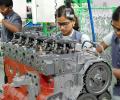
Genset manufacturer Cummins India has seen its share price rise by 45 per cent in the past three months. The management has reaffirmed that growth would be in double digits over the coming two fiscal years. Growth is expected to be driven by a pickup in domestic infrastructure spending.

'Those trying to use these funds for quick gains should avoid them due to risk of being late to the party.'

Consumption was the major driver, contributing 58.8 per cent to GDP growth

Modi and Albanese also reiterated their shared ambition for an early conclusion of the ambitious Comprehensive Economic Cooperation Agreement (CECA) that is expected to significantly expand bilateral trade ties.

'The two sides agree to continue firmly supporting each other in safeguarding their respective core interests,' a joint statement issued at the end of Muizzu's talks with Chinese leaders said.

'At this moment you cannot give her asylum because if you do, then you are directing public anger against India.'

Abhishek stole the show with his belligerent knocks for runners up SRH, while Fraser-McGurk emerged a surprise batting hero for DC and Rana was one of KKR's best bowlers.

tailwinds of a remarkable year and handsome investor returns, Indian equities are set for an eventful journey in 2024, with a slew of local and global cues -- varying from interest rates to Lok Sabha polls to geopolitical happenings. Analysts are of the view that the bull run in the domestic equity market will continue, and over the next 3-6 months, the benchmark indices -- Sensex and Nifty -- could climb up to 7 per cent. In 2023, the 30-share BSE Sensex jumped 11,399.52 points or 18.73 per cent, and the NSE Nifty climbed 3,626.1 points or 20 per cent.

Finance Minister Nirmala Sitharaman on Tuesday said the securities transaction tax (STT) will be increased on futures and options (F&O) trade from October 1 to discourage retail investors from investing in the risky instrument.
